What Is Flat Towing? We Explain Every Dinghy Thingy

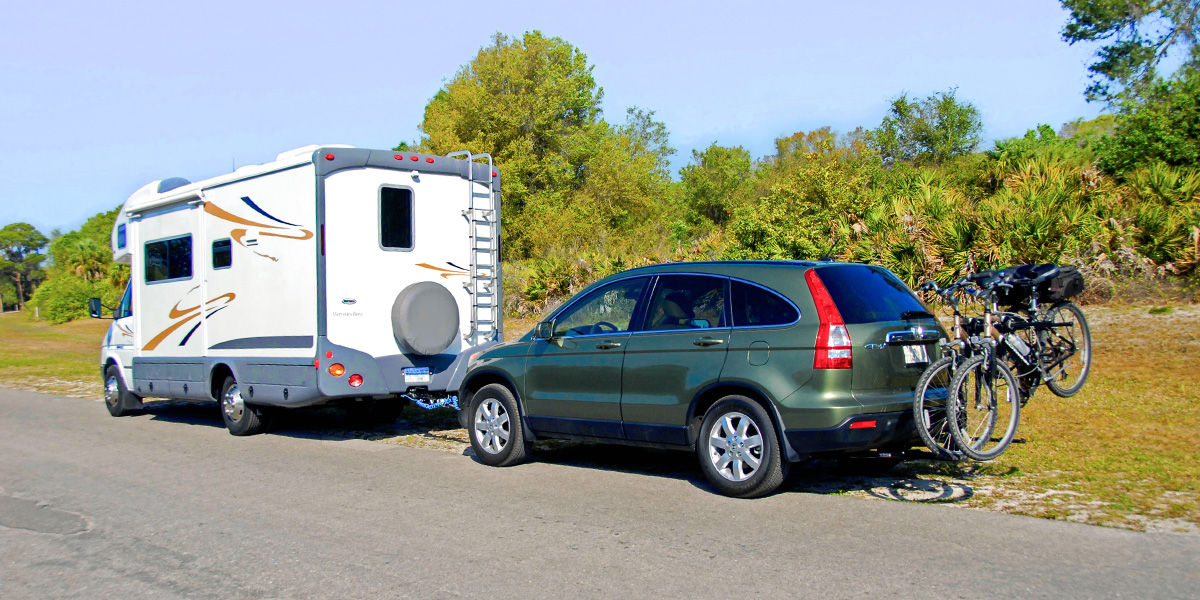
My wife and I flat-towed our Jeep Grand Cherokee behind our Class C through mountains, long highway stretches, and all kinds of landscapes. We didn’t do much serious off-roading while connected, but we definitely crossed some dirt roads and reached places where having the Jeep made the entire trip better.
Flat towing sounds like something that should be simple. Connect a vehicle behind the motorhome, put all four wheels on the ground, and drive away. And technically, that is what you’re doing.
Flat towing gave us the convenience of a smaller vehicle without pulling a full trailer. But it also gave us another vehicle, braking system, lighting setup, tow bar, baseplate, safety cables, and checklist to think about. So, yes, it’s convenient. But it isn’t quite “hook it up and forget it.”
Before anyone attaches the family SUV to the back of an RV and heads toward the mountains, there are a few dinghy thingies worth understanding.
What Flat Towing Actually Means
Flat towing means pulling a vehicle behind a motorhome with all four of the towed vehicle’s wheels on the road. It’s also called dinghy towing or four-down towing. The vehicle being pulled is often called the dinghy, toad, or towed vehicle. I’m not sure who first decided to call a full-size SUV a dinghy, but the boat lover in me guesses it was someone with a yacht.
Unlike a tow dolly, which lifts the vehicle’s front wheels, or a trailer, which carries the entire vehicle, flat towing uses a tow bar to connect the vehicle directly to the motorhome. When you turn, the towed vehicle’s front wheels steer and follow the motorhome. At least, that’s the plan.
Not Every Vehicle Can Be Flat Towed
Read this before buying any equipment: A vehicle isn’t automatically flat-towable just because it has four-wheel drive, a neutral position, or someone online says they’ve been doing it for years. Some vehicles can be flat towed exactly as they leave the factory. Others require specific procedures or approved equipment. Some can only be towed on a dolly or trailer. Others shouldn’t be recreationally towed at all.
Always check the owner’s manual for the exact year, model, drivetrain, engine, and transfer-case configuration. Look specifically for a section titled Recreational Towing, Towing Behind a Motorhome, or something similar. Don’t rely on the instructions for another model year. Manufacturers can change transmissions and drivetrains while leaving the outside of the vehicle looking almost identical.
If the manual says the vehicle can’t be flat towed, believe it. Don’t let a couple of YouTube videos about a previous model convince you otherwise. The wrong setup can damage the transmission, transfer case, drivetrain, steering system, or other components.

The Main Parts of a Flat-Towing Setup
A proper system requires more than one metal bar between two vehicles. The main pieces usually include:
- A vehicle-specific baseplate
- A properly rated tow bar
- Safety cables
- Supplemental braking system
- Breakaway system
- Brake, turn-signal, and taillight setup
- Electrical cord or wireless transmitter, depending on the system
- An appropriately rated motorhome hitch
- A drop or rise receiver, if needed for proper tow-bar alignment
The baseplate attaches securely to the towed vehicle and provides the connection points for the tow bar. Baseplates are vehicle-specific and attach to structural points beneath the vehicle. You can’t just buy any connections and assume they’ll work on your vehicle.
The tow bar connects the baseplate to the motorhome’s hitch receiver. The safety cables provide a separate backup connection if the tow bar or another part of the primary connection fails. They should be rated for the towed vehicle and connected according to the manufacturers’ instructions.
Every component needs to be rated for the actual weight of the vehicle you’re towing. The weakest rating in the system is the one that matters.
The Towed Vehicle Needs Its Own Brakes
A motorhome may be able to pull a vehicle without supplemental brakes. Stopping it safely is another conversation.
A supplemental braking system applies the towed vehicle’s brakes when the motorhome slows down. That reduces the workload on the motorhome’s brakes and can improve stopping control, especially on mountain grades or during an emergency.
Braking requirements vary by state and province. Some laws use the weight of the towed vehicle, while others are based on stopping-distance requirements or other standards. That means you should check the rules everywhere you plan to travel – not just in your home state. Even where the legal wording seems less direct, I’d still use a properly installed supplemental braking system.
A breakaway system is also important. If the vehicle separates from the motorhome, the breakaway switch activates the towed vehicle’s brakes rather than allowing it to continue rolling freely down the road.
We towed through too many mountains to think adding thousands of pounds behind the motorhome without additional braking was a good idea. Nobody wants to go viral because their dinghy decided to roll down the highway on its own.
Our Portable Braking Setup
Instead of permanently installing a remote braking system in our towed vehicle, we used a portable system. Our particular unit sits on the driver-side floor, connects to the brake pedal, and applies the Jeep’s brakes when the motorhome slows. A wireless controller in the motorhome allows us to monitor and adjust the system from the driver’s seat.
We chose a portable system because we wanted the ability to move it to another compatible vehicle if we changed what we were towing. That flexibility was the big advantage; the tradeoff was setup. Every time we connected, we had to place the unit correctly, attach it to the pedal, power it, configure it, and confirm it was operating properly. That being said, this system worked well for our needs and gave us the portability we wanted.
The Towed Vehicle Still Needs Lights
Drivers behind you need to see brake lights, turn signals, and taillights on the vehicle at the very back of the combination.
Many flat-towing setups use permanent wiring that connects the motorhome’s lighting system to the towed vehicle’s existing lights. We wanted something we could remove and potentially use on another vehicle, so we chose wireless magnetic brake and signal lights instead. A transmitter connected to the motorhome sends the lighting signals wirelessly to the removable lights on the Jeep.
A wireless system meant we did not have to modify the Jeep’s factory lighting system and it could be easily moved between vehicles. The downside was having more removable equipment to position, charge or power, test, and store. And magnetic lights need a clean, secure, and suitable mounting surface. You don’t want to arrive at your destination and realize one of your taillights chose a different exit 200 miles ago.
Whichever system you use, test the brake lights, running lights, and both turn signals before every drive.
Follow the Vehicle’s Setup Procedure Exactly
Once the hardware is connected, the towed vehicle still has to be prepared for travel. Depending on the vehicle, that may involve:
- Shifting the transfer case into neutral
- Placing the transmission in a specific position
- Releasing the parking brake
- Changing an ignition or accessory setting
- Disabling or activating certain vehicle features
- Removing or installing a fuse
- Disconnecting the battery or adding a charge line
- Starting the engine at specific mileage or time intervals
Those are examples, not universal instructions. Follow the procedure in your exact vehicle’s owner’s manual in the correct order. Skipping one small step can create a very large repair bill.
You Usually Can’t Back Up
One major flat-towing limitation is that you generally can’t safely back up with the vehicle connected and should disconnect before reversing. The towed vehicle’s front wheels can turn unpredictably while reversing, placing side loads on the tow bar, baseplate, and steering system. Manufacturers commonly recommend disconnecting and moving the vehicles separately when backing is necessary.
This matters more than you may think. So, before entering a gas station, parking lot, campground road, or questionable dead end, make sure you can pull through or turn around. A normal wrong turn becomes much more annoying when correcting it requires stopping, disconnecting the Jeep, moving two vehicles, and hooking everything up again.
Ask me how I know.
Do a Full Connection Check
Before driving away, check:
- Tow-bar arms are fully locked
- Pins and retaining clips are installed
- Safety cables are connected properly
- Breakaway cable is attached separately
- Electrical or wireless lighting system works
- Supplemental brake is installed and tested
- Towed vehicle is in the correct towing mode
- Parking brake is released
- Tires are properly inflated
- Motorhome hitch and tow-bar ratings are sufficient
- Tow bar is within the manufacturer’s allowable level or angle range
- Doors, hood, and rear hatch are closed
Then pull forward slowly and confirm that everything tracks properly.
After the first few miles, stop somewhere safe and check the entire setup again. A pin takes five seconds to inspect. Discovering that it wasn’t secured takes considerably longer.
I also recommend slowing down and double-checking everything because we may or may not have driven off a couple of times with the parking brake still engaged. Luckily, there was no permanent damage, but it was a memorable reminder to stay alert and follow the checklist.
Is Flat Towing Worth It?
For us, absolutely. Having a separate vehicle gave us the freedom to set up the Class C and then explore without breaking camp every time we wanted groceries, dinner, a trailhead, or a rougher road. Flat towing was also faster and easier to manage than loading a vehicle onto a full trailer.
On the other hand, it added weight, length, equipment, maintenance, and another checklist to every travel day. It also meant planning fuel stops, turns, and parking areas around the fact that backing up wasn’t a realistic option while connected.
Flat towing is convenient because the setup disappears into the background once you’re moving. The key is making sure it doesn’t disappear from your attention before you leave. Check the vehicle manual. Match every component to the weight. Use supplemental brakes and a breakaway system. Test the lights. Follow the setup procedure. And inspect every connection before putting two vehicles’ worth of trust into a handful of pins and cables.
Once you get the routine down, flat towing really does become simple and second nature. At least, RV simple – meaning it gets easier after you learn every dinghy thingy that can go wrong.
Gabriel Rivero